 UK Site

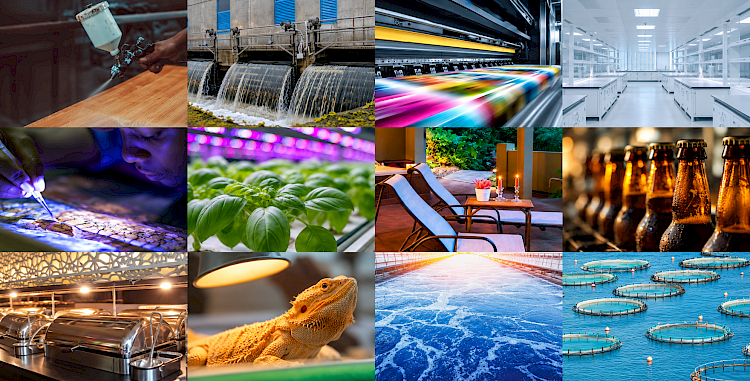
IR and UV: The Industries You'd Never Expect to Find Them In
Ask most people where infrared and ultraviolet light show up in manufacturing, and they would probably offer the obvious answers: UV disinfection in healthcare, maybe IR heating in industrial ovens.
They wouldn't think of the water in a fish farm. Or the label on a beer bottle. Or the DWR finish on a running jacket. Or the conveyor belt in a food processing facility.
But that's exactly where IR and UV technology are already working — quietly, reliably, and in many cases doing something that no other technology does as well.
We work with customers across a wide range of industries, and one of the things we encounter most often is the gap between what IR and UV technology can do and what the people who need it most know about it.
This article is our attempt to close that gap — a tour through four industries where light-based processing is already playing an important role, often unrecognized, and increasingly providing an alternative or complement to conventional chemical and thermal processes.
Textiles: The Invisible Layer in Your Technical Fabric
Take the textile and technical fabric industry, where manufacturers and brands are facing growing pressure to move away from PFAS-based chemistries.
PFAS — per- and polyfluoroalkyl substances, often referred to as “forever chemicals” — have been widely used in durable water repellent (DWR) finishes on performance fabrics for decades.
Across the US, the regulatory landscape surrounding PFAS continues to develop, with restrictions and reporting requirements emerging at both federal and state levels. At the same time, brands, retailers and manufacturers are increasingly looking for alternatives to PFAS-containing treatments.
The challenge for textile finishers isn't simply swapping one chemical for another. It's maintaining the performance properties their customers expect — including water resistance and durability through repeated use and washing — using the next generation of PFAS-free chemistries.
And that's where the curing and drying process becomes just as important as the chemistry itself.
Many PFAS-free DWR alternatives are water-based formulations. Achieving a consistent, durable finish on a water-based coating — without unnecessarily heating the entire process environment — is an application where infrared technology can offer significant advantages.
IR delivers energy directly to the coating and substrate rather than relying solely on heating the surrounding air, allowing drying systems to be designed around the specific material and process requirements.
UV curing can also be used with compatible reactive chemistries to achieve rapid, controlled curing and cross-linking.
Together, IR and UV technologies can provide textile manufacturers with additional processing options as the industry moves toward new finishing chemistries.
For the textile and technical fabric industry, IR and UV aren't simply add-ons. They can form an important part of how the next generation of finishing technology gets to work.
Explore IR and UV technology across specialist industries →
Food Processing: Reducing Reliance on Chemicals with Light
Food and beverage processing is one of the most demanding hygiene environments in US manufacturing, with processors continually looking for ways to strengthen sanitation while maintaining production efficiency.
Chemical sanitizers remain an essential part of food safety programs. Chlorine-based compounds, peracetic acid and other sanitizing agents can be highly effective, but they also introduce considerations around procurement, handling, storage, residues and disposal.
UV-C disinfection provides another tool for controlling microorganisms without introducing additional chemicals into the treatment process.
UV-C works by disrupting the genetic material of microorganisms such as bacteria, viruses, molds and fungi, preventing them from reproducing.
Because the process is physical rather than chemical, UV-C treatment leaves no chemical residue and can be engineered directly into production equipment and processing environments.
Applications can include surface disinfection, packaging treatment, process water treatment and air treatment through HVAC or air-handling systems.
Each represents a point in the production process where UV-C can potentially complement existing sanitation procedures and help reduce reliance on chemical treatment.
For US food processors balancing food safety, operational efficiency and increasingly automated production environments, UV-C is a well-established technology with applications across a wide range of hygiene and disinfection processes.
Read more: How UV-C Is Replacing Chemical Sanitizers on Food Processing Lines →
Explore our food processing solutions →
Aquaculture: Clean Water, Without Adding Chemistry
Perhaps the sector that surprises people most: fish farming and aquaculture.
Aquaculture operations depend heavily on water quality. Whether it's a hatchery, an intensive production facility or a recirculating aquaculture system (RAS), the animals live in the water, grow in it and are constantly exposed to whatever microorganisms it carries.
Managing that microbiological load is therefore a critical part of maintaining healthy production conditions.
UV-C water treatment provides a way to inactivate microorganisms in the water column without adding treatment chemicals directly to the water.
As water passes through an appropriately designed UV reactor, UV-C energy can inactivate bacteria, viruses and other microorganisms by disrupting their ability to reproduce.
No chemical residue is added to the water, and the treatment process can operate continuously as part of the facility's water-management system.
In RAS facilities in particular, where water is treated and recirculated continuously, UV-C can form an important part of the overall water treatment and biosecurity strategy.
UV-C-treated water can also support hatchery applications, helping operators manage microbiological risks during vulnerable stages of production.
We supply a wide range of UV-C disinfection and replacement lamps for water treatment applications, including replacement lamps compatible with systems from major UV equipment manufacturers.
Explore UV-C water treatment solutions →
Explore our full UV-C disinfection lamp range →
Labels and Narrow Web: The Lamp That Runs Your Press
The label and narrow web printing industry is in the middle of a technology transition.
Mercury arc UV curing has been a standard technology for narrow web label printing for decades. It works, but conventional systems can be energy intensive, generate significant heat and use mercury-containing lamps that require appropriate handling and disposal.
UV LED curing changes the way UV energy is delivered to the press.
Instead of producing a broad spectrum of UV energy, LED systems deliver concentrated output at specific wavelengths selected to work with compatible inks, coatings and adhesives.
With significantly lower heat transfer to the substrate, UV LED can also be well suited to heat-sensitive films and other materials that may be more challenging to process under conventional mercury UV.
UV LED systems switch on and off instantly, so energy is consumed when curing is required rather than during the warm-up and standby periods associated with conventional mercury systems.
Service life can also be significantly longer than conventional UV lamps, reducing the frequency of lamp replacement and associated maintenance.
For label converters, the potential benefits can span energy consumption, substrate versatility, press uptime, maintenance requirements and operating costs.
Our UV curing range includes dedicated Flexo and Digital UV LED systems, alongside conventional UV curing technologies and configurations designed for different production requirements.
Existing presses may also be candidates for a UV LED retrofit rather than requiring complete replacement, depending on the press, ink chemistry, required wavelength, working width and production speed.
Explore our Flexo UV LED System →
Explore our full UV curing lamps and systems range →
Beyond the Four: Where Else Does This Show Up?
These four industries make a compelling case, but they're far from the whole story. IR and UV technology shows up in places that are even less expected.
In horticulture and controlled-environment agriculture, carefully controlled UV technology can influence plant development and secondary metabolite production, while infrared technology can provide targeted warmth for propagation and controlled growing environments.
Both technologies can play a role in crop quality, environmental control and energy efficiency.
You can explore horticulture and vertical farming alongside Victory's other specialist applications in our Light You Never Knew You Needed hub →
In craft breweries, distilleries and wineries, UV-C technology can be used for process water and hygiene applications without introducing chemical residues into the treatment process.
For producers where consistency, microbiological control and product quality are critical, that can be particularly valuable.
In pharmaceutical and cleanroom environments, UV-C disinfection can be integrated into wider contamination-control programs as a complement to established cleaning and disinfection methods.
It provides a repeatable, residue-free approach to air and surface treatment when the application, UV dose and operating conditions are correctly designed and validated.
In each case, the pattern is the same: an industry with a real process challenge, an established chemical or thermal approach carrying its own costs and complications, and IR or UV providing another way to improve efficiency, process control or hygiene.
Explore how IR and UV are used across specialist industries →
The Bigger Picture
Four main industries. Three supporting ones. One consistent theme: IR and UV are already doing work that many of the people running these operations don't know they're doing — or don't yet know could be done differently.
The transition away from PFAS in textiles, the drive to optimize sanitation processes in food production, the importance of water quality and biosecurity in aquaculture, and the energy and technology transition taking place in narrow web printing — these are real industry challenges.
IR and UV aren't theoretical solutions to future problems.
They're technologies already being applied to challenges manufacturers and processors are dealing with today.
That's the light you never knew you needed.
Want to find out where IR or UV could fit into your process?
Explore The Light You Never Knew You Needed → or speak to our Victory North America team about your application.

VICTORY
Ready to discuss specific products or a custom solution?