 UK Site
Turn Your Patio Into a Year-Round Revenue Stream: The Case for Infrared Heating

VICTORY
Ask any restaurant owner in the US what their outdoor patio is worth, and they'll give you a number fast. More covers, more turns, better margins on drinks and a curb appeal that draws walk-in traffic off the street. According to a Zagat survey, 77% of diners are in favor of outdoor seating, the appetite for open-air dining hasn't faded since the pandemic accelerated it. If anything, it's more popular than ever.
The problem is that a patio only earns when it's being used. Once temperatures drop—in Chicago, Denver, Boston, or even Nashville—the covers stop turning and that revenue walks back inside. The question every operator faces is how far into fall and winter they can realistically keep their outdoor space working for them.
The answer depends on the heating technology they choose. And a growing number of US restaurants, hotels, and bars are moving away from propane mushroom heaters toward wall-mounted and overhead electric infrared systems, not as an aesthetic upgrade, but as a direct revenue decision.
What's Wrong with Propane
Propane mushroom heaters are the default for a reason. They're portable, they're familiar and they don't require any fixed installation. For a restaurant that added outdoor seating quickly during the pandemic and hasn't revisited the infrastructure since, they're still the path of least resistance.
But propane heaters have a fundamental inefficiency that shows up every night in running costs: they heat air. Outdoor air is functionally infinite. No matter how many BTUs a propane mushroom heater produces, the heat disperses into the surrounding atmosphere faster than it reaches your guests. Infrared radiant heaters waste no time or energy heating outdoor air. Instead, their electromagnetic waves transfer heat onto nearby solid surfaces at the speed of light.
There's also the operational reality. It's common to have to replace a gas heater's canister during a long evening outdoors, meaning you need to keep spare canisters in stock, just in case. For a front-of-house team managing a Friday night service, swapping propane tanks mid-shift is exactly the kind of operational friction that costs time and chips away at the guest experience. A tank that runs dry at the wrong moment doesn't just mean a cold table... it means a table that's likely asking for the check.
Propane heaters also have a wind problem. Heat produced by convection—warming the surrounding air—gets deflected by a breeze before it reaches the people you're trying to keep comfortable. The heat from gas models is often deflected in breezy conditions, making them a less consistent heat source. On a rooftop bar in October, or a patio along a city corridor, that inconsistency is a real operational liability.
How Infrared Works and Why It's Different
Infrared heating works the way the sun works. It emits electromagnetic radiation that travels through the air and heats the surfaces and bodies it strikes directly — your guests, the chair backs, the table tops. The ambient temperature is almost irrelevant. What matters is the radiant intensity reaching the person in the seat.
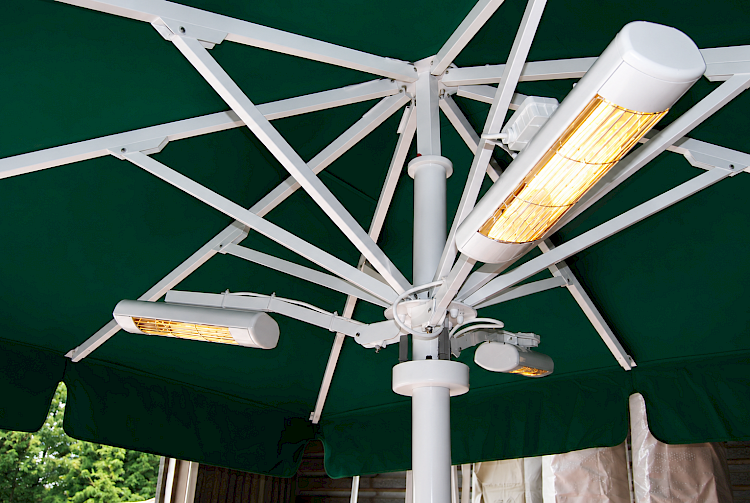
Instead of warming all the surrounding air, electric infrared heaters send heat straight to people and nearby objects, making them efficient. This direct method works well for covered patios and urban outdoor spaces.
The practical results for a restaurant operator are significant:
Instant heat, no warm-up. Infrared heaters deliver warmth the moment they switch on, producing warm, comforting heat at the flick of a switch. Guests feel the benefit as soon as they sit down. No waiting, no gradual build-up, no cold first ten minutes while the heater finds its pace.
Wind resistance. Because IR transfers heat by radiation rather than convection, wind doesn't deflect it. The guest experience is consistent even in exposed outdoor environments: rooftop decks, waterfront terraces, urban sidewalk dining, open courtyards.
Zone control and energy management. Electric IR systems can be zoned, dimmed, put on timers, and triggered by occupancy sensors. Heat is only delivered when and where guests are present. Combined with soft-start timing controllers and remote control, they give operators precise control over both the guest experience and the energy cost. A propane heater runs at full output or not at all. An IR system gives you a dial.
Clean installation. Wall-mounted and ceiling-mounted IR heaters free up floor space entirely; no freestanding units to navigate around, no propane cylinders to store, no risk of tip-overs. Their slim design lets you fit them neatly under awnings or alongside pergolas, keeping heat right where guests gather. The patio looks intentional rather than improvised.
The Season Extension Math
Imagine extending your outdoor dining season by three whole months. For a restaurant doing solid weekend covers on its patio, three additional months of shoulder-season and early winter service represents a meaningful revenue line, one that doesn't require more staff, more kitchen capacity, or any new marketing spend. The seats are already there. The question is whether the environment keeps guests in them.
More than 58% of restaurants depend on heating systems to increase seating capacity by 25–35% during cold seasons, with commercial operators reporting up to 32% higher customer retention after installing heaters. The case for outdoor heating in general is well established. The case for infrared specifically comes down to how much of that investment converts directly into guest comfort, and how much is lost heating the atmosphere around them.
IR's direct radiant delivery means more of every dollar spent on energy reaches the intended target. Paired with zoned control and occupancy sensing, an electric IR system typically runs at significantly lower cost per occupied cover than a propane programme of equivalent coverage.
The Regulatory Signal
There is no federal ban on propane patio heaters in the US. But the regulatory direction in major hospitality markets internationally is worth noting for operators planning medium-term infrastructure decisions.
France banned the use of gas patio heaters in 2022. From January 2025, gas-powered patio heaters became illegal in Barcelona. Several other European cities are actively considering similar restrictions. The argument, that continuously burning fossil fuel to heat open outdoor air is an avoidable source of emissions, is consistent with the trajectory of sustainability regulation across commercial sectors in the US as well.
For hospitality operators who have made public sustainability commitments, or who operate in cities and states with active commercial energy reduction targets, the shift from propane to electric IR heating is a decision that gets easier to justify the longer it's delayed.
Where We Come In
We manufacture and supply infrared lamps and fittings for commercial and industrial applications. and outdoor comfort heating is one of the areas where our Infrared range is most directly relevant to the hospitality sector.
The lamp at the heart of an outdoor IR heater determines how it performs: the wavelength it emits, the intensity at operational mounting height, the heat distribution across the coverage zone and how consistently it maintains output across its rated lifespan. Getting the specification right is the difference between a heater that genuinely keeps guests at the table and one that looks the part but underdelivers on a cold October night.
We work with equipment manufacturers, specifiers, and facilities teams across commercial hospitality. If you're evaluating outdoor heating for a new installation, upgrading an existing propane programme, or specifying across multiple venues, we're happy to talk through the lamp and system options.
Your patio is a revenue asset. The heating that makes it work year-round is the light you never knew you needed.
Find the right infrared heating for your outdoor hospitality space
Whether you're replacing propane across an existing venue or specifying a new installation from scratch, our team can help you get the lamp and system specification right, so that every dollar you spend on energy reaches your guests, not the sky above them.
Talk to our team about your outdoor heating or explore our infrared heating range.
Ready to discuss specific products or a custom solution?